
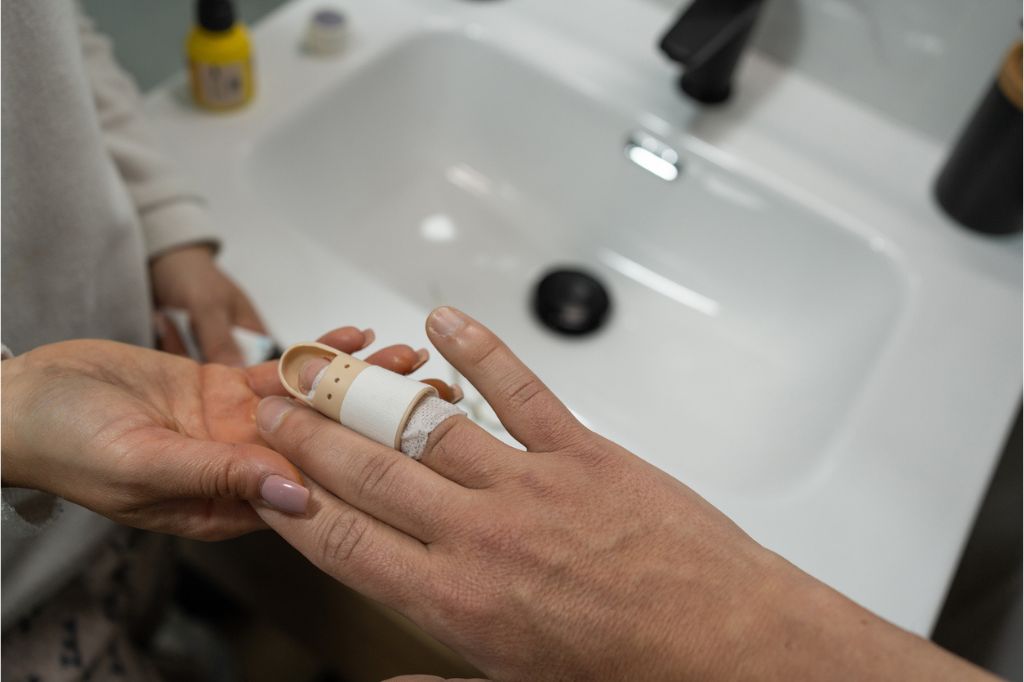
It happens in an instant. A basketball clips the end of your finger during a rebound, or a bedsheet catches your fingertip the wrong way. Suddenly, the tip of your finger hangs limp, pointing toward the floor, and no amount of effort can straighten it back up. That’s a mallet finger, and it’s more than an inconvenience.
Mallet finger is one of the most common tendon injuries seen by orthopedic hand specialists, affecting athletes, weekend warriors, and people going about everyday life with equal frequency. Despite how small and seemingly minor the injury looks, leaving it untreated can lead to lasting deformity and reduced hand function. Understanding what’s happening inside the finger and what to do about it makes all the difference in how well it heals.
What Is Mallet Finger and Why Does It Happen?
Mallet finger occurs when the extensor tendon, the thin band of tissue responsible for straightening the tip of a finger, is disrupted at the distal interphalangeal (DIP) joint, which is the joint closest to the fingertip. When this tendon is torn or detached, the fingertip loses its ability to extend and droops into a bent position.
The injury typically occurs when a hard, unyielding object strikes an outstretched fingertip, forcing it into sudden, forceful flexion. Ball sports are common culprits, which is why mallet finger is sometimes called “baseball finger,” though it also shows up in basketball, volleyball, and football. Surprisingly, everyday activities are responsible for many cases too, including making the bed, tucking in sheets, or catching a finger on clothing.
Two Types of Mallet Finger
Not all mallet finger injuries are alike. In soft tissue mallet finger, the tendon itself tears or ruptures. In bony mallet finger, the tendon pulls away from its attachment point and takes a small fragment of bone with it, a type of injury called an avulsion fracture. Both types cause the same visible drooping deformity, but distinguishing between them matters because it influences the treatment approach. An X-ray can identify whether bone is involved, which is why imaging is a standard part of any mallet finger evaluation.
Who Gets Mallet Finger?
The injury doesn’t discriminate. Research shows it can affect people across a wide age range, from active teenagers to adults well into their fifties and beyond. Men are injured more frequently than women, though women account for a meaningful share of cases. Athletes involved in catching sports face the highest risk, but a significant number of patients have no athletic history at all.
What Happens When Mallet Finger Goes Untreated
The fingertip droop is uncomfortable and inconvenient enough on its own. The greater concern is what happens to the surrounding structures when the injury isn’t addressed.
How Tendon Imbalance Causes Further Damage
When the extensor tendon is disrupted at the DIP joint, it throws off the precise balance of forces that governs how a finger moves. Over time, the tendon imbalance causes the middle joint of the finger, the proximal interphalangeal (PIP) joint, to hyperextend while the fingertip remains flexed. According to the American Academy of Orthopedic Surgeons, this cascade of structural changes can result in a swan-neck deformity, a condition in which the finger takes on an abnormal S-shaped curve that significantly limits function and can become permanent if not corrected.
Why Early Treatment Matters
The window for the most effective conservative treatment is relatively short. Splinting, the standard first-line approach, yields the best results when started promptly after the injury. Research confirms that delayed treatment makes achieving full extension recovery considerably harder. Waiting weeks or months before seeking care shifts treatment options toward more complex interventions, including surgical reconstruction or joint fusion in the most chronic cases.
Treatment Options for Mallet Finger
Most mallet finger injuries respond well to non-surgical treatment when managed correctly. A review of 26 studies covering over 1,100 treated fingers found that conservative splinting achieved successful outcomes in roughly 77 percent of acute mallet finger cases, with patient satisfaction rates near 83 percent.
Splinting: The Cornerstone of Recovery
Treatment centers on holding the DIP joint in full extension using a splint, a position that brings the torn tendon ends close enough together to allow healing. The splint must be worn continuously, day and night, for six to eight weeks. Removing it, even briefly, during the healing period can disrupt the process and significantly set recovery back.
Several splint designs exist, from prefabricated stack splints to custom-fabricated thermoplastic options shaped by hand therapists. The right choice depends on the patient’s activity level, compliance, skin tolerance, and whether the mallet finger involves a tendon tear or a fracture fragment. Regardless of the design, strict adherence to the splinting schedule is the single most important factor in achieving a good outcome.
When Surgery Becomes Necessary
For most closed mallet finger injuries without a fracture, surgery is not the default recommendation. The extensor tendon at the fingertip is extremely thin, and suture repairs are technically difficult and carry significant risks, including infection, nail deformity, and joint stiffness. A retrospective review of 123 mallet finger cases found a 53 percent complication rate in surgically treated patients, compared to favorable results in those managed with splinting.
Surgery is considered when a large fracture fragment is involved, when the joint shows signs of instability or subluxation, or when conservative treatment has failed over an extended period. In these situations, a hand surgeon may use Kirschner wires to stabilize the joint internally, acting as a temporary internal splint while healing occurs.
Returning to Activity
Even after the formal splinting period ends, athletes and patients performing manual work should continue to protect the finger with a splint or buddy taping during activity for an additional 6 to 8 weeks. This reduces the risk of re-injury during the period when the healed tendon is still regaining its full tensile strength.
When to See a Specialist for Mallet Finger
Some finger injuries seem minor enough to manage with a store-bought splint and a wait-and-see approach. Mallet finger is not one of them. A proper evaluation is important to confirm the diagnosis, identify whether bone is involved, and establish a structured treatment plan.
Seek specialist care if you notice any of the following:
- A fingertip that droops and cannot be actively straightened, with or without pain
- Swelling, bruising, or tenderness at the end joint of a finger after a direct impact
- A “snap” or pop felt at the fingertip at the time of injury
- Symptoms that have persisted for more than a week without improvement
- A finger that appears deformed or bent in an unusual direction
- Pain or dysfunction after a previous mallet finger that was never properly treated
Located in Fort Lauderdale, Orthopedic Specialty Institute serves patients throughout South Florida, including Broward, Palm Beach, and Miami-Dade Counties. Our hand and orthopedic specialists have extensive experience evaluating and treating mallet finger injuries at every stage, from acute tendon tears to chronic cases requiring advanced intervention. Request an appointment online today.
